





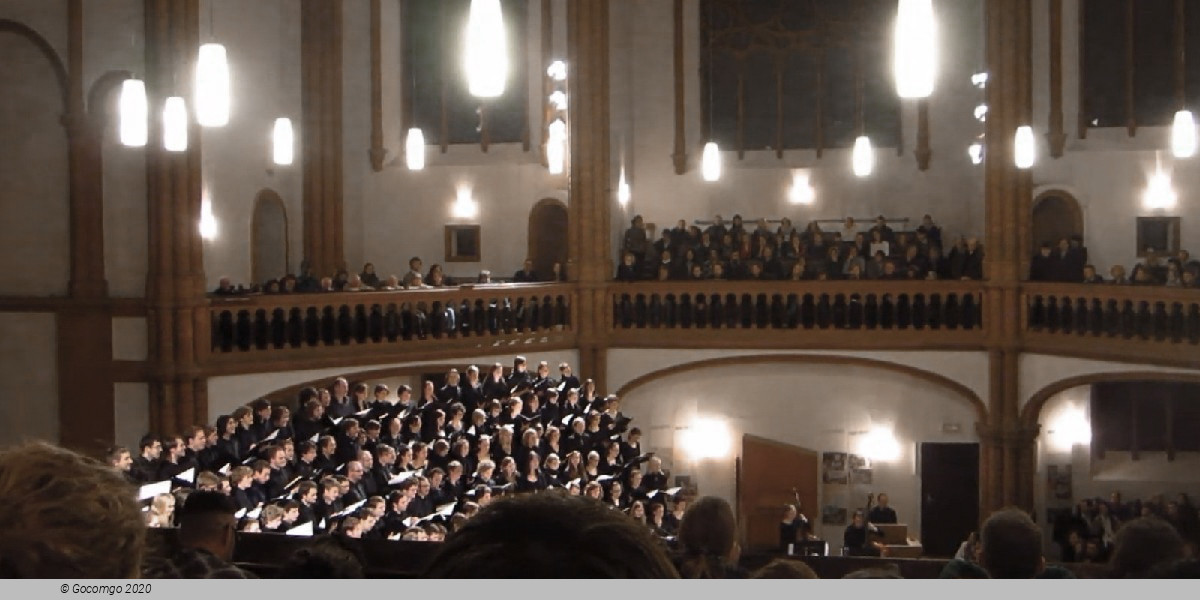
About
The Berlin Philharmonic Choir was founded in 1882 by Siegfried Ochs as "Siegfried Ochs'scher Gesangsverein". His first independent concert was held with the Berliner Philharmoniker orchestra (today the Berliner Philharmoniker) and renamed in 1887 to the Berliner Philharmoniker choir.
After 37 years under the influence of Ochs, Otto Klemperer took over the artistic direction of the choir from 1929 to 1933. Carl Schuricht (until 1935), Günther Ramin (until 1943) and from 1943 until his death in 1981, the composer and conductor Hans Chemin-Petit followed. From 1982 to 2002 the choir was led by Uwe Gronostay.
Jörg-Peter Weigle has been artistic director of the Berlin Philharmonic Choir since 2003.
The Berliner Philharmoniker is one of the most renowned and traditional oratorio choirs in Germany. Founded in 1882 by Siegfried Ochs and led until 1929, the choir was led by Otto Klemperer, Carl Schuricht, Günther Ramin, Hans Chemin-Petit and Uwe Gronostay in the following decades. Since the 2003/2004 season, the artistic direction of the Berlin Philharmonic Choir has been in the hands of Jörg-Peter Weigle.
In the course of its 130-year history, the Berlin Philharmonic Choir was always committed to the overall spectrum of Oratorio literature, so that in addition to the standard works always unknown, unusual and New appeared in his concert programs. Many works, which are now part of the standard literature to count, were first performed by the Berlin Philharmonic Choir - or for Germany, for example Anton Bruckner's 'Te Deum',' the lamenting song ' by Gustav Mahler,' The Fireman ' by Hugo Wolf,' the incessant ' by Paul Hindemith as well as works by Reger, Honegger, David, Chemin-Petit and H. W. Zimmermann. In 2008 this Tradition was re-recorded with the world premiere of Bernd Franke's composition 'Miletus'. In addition, the choir celebrated its 125th anniversary as a first-rate cultural institution and stepped up its social and cultural commitments. With topics such as youth work, the promotion of young talent and the networking of the European Choral system in theory and practice through meetings and cooperation, the choir wants to meet its educational mission more closely.
As in the early decades of his existence, in which Siegfried Ochs prepared the Berlin Philharmonic Choir for concerts with conductors such as Hans von Bülow, Richard Strauss or Arthur Nikisch, he has been and will again and again be invited to the Berlin orchestras, which perform in the Philharmonie and in the Konzerthaus, and was a Partner of conductors such as Claudio Abbado, Riccardo Chailly, Vladimir Ashkenazy, Kent Nagano and Michael Schønwandt. Gerd Albrecht, Claus Peter Flor, Lord Yehudi Menuhin, Antal Dorati and Eric Ericson also enjoyed working with the Berlin Philharmonic Choir. Radio, television and CD productions, concerts in Vienna and Frankfurt am Main under Claudio Abbado, in Copenhagen, under Leif Segerstam, in Amsterdam, under the direction of Uwe Gronostay and in Salisbury under the direction of Uwe Gronostay and David hall, in London's St. Paul's Cathedral under Sir David Willcocks, in Hanoi/Vietnam, under Jonas Alber, in Merseburg, Halle and Neubrandenburg, as well as the turn of the year 2012/13 in Shenzhen/China under Jörg-Peter Weigle and Christian Ehwald complete the picture.
Already with his first concert as artistic director of the Berlin Philharmonic Choir in November 2003, Jörg-Peter Weigle showed that he is also interested in expanding the Repertoire for both the choir itself and its audience. The re-performance of Georg Schumann's oratory 'Ruth' after more than fifty years has allowed the audience to listen far beyond Berlin, Robert Schumann's 'scenes from Goethe's Faust' to be performed for the first time in the history of the choir, and the Requiem of Hector Berlioz was again included in the repertoire of the Berlin Philharmonic after almost 100 years of Following on from its predecessors, in particular, Siegfried Ochs, Hans Chemin-Petit and Uwe Gronostay, who have confronted their audiences with new works, and "archaeological excavations" of forgotten music, Jörg-Peter Weigle, always curious about new discoveries, and the soon to be ten-year collaboration with the Philharmonic Choir of Berlin, presented to him as a fascinating, diverse cross-section of the history of the choral-symphonic music.