




About
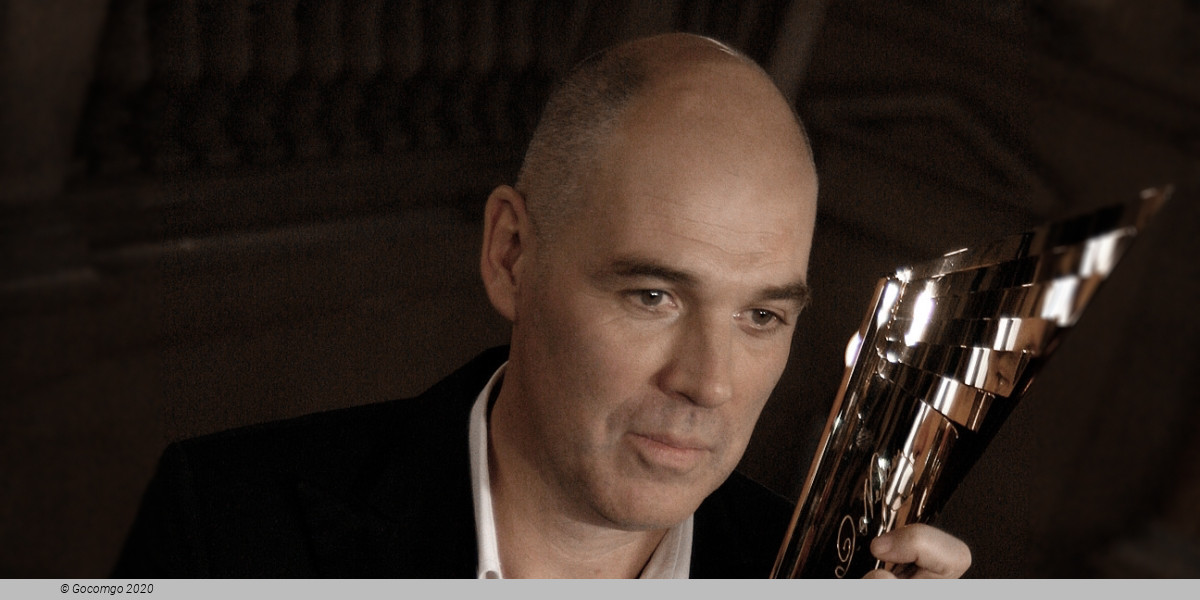
Matthias Hartmann (born June 27, 1963 in Osnabrück) is a German theater director and artistic director. From 2009 to 2014 he directed the Burgtheater in Vienna. He lives with his family in Egg (Thalgau).
After visiting a boarding school in Gloucester, England from 1977 to 1981, he returned to his native city, broke off shortly before graduation from high school and traveled abroad. From there soon returning, he attended in 1983, the drama school in Stuttgart, took in 1985, his high school and took on two commercial lessons, which he broke off; at her instead, Hartmann turned to the theater work. His career as a theater director began Hartmann as a guest student at the Schiller Theater Berlin, after which he worked as a freelance director at the houses in Kiel, Mainz and Wiesbaden. His first self-directed production Hartmann worked in 1989 with daydreams at the Theater Kiel.
Theater management in Hannover, Bochum and Zurich
In 1990 he became artistic director and director of the Niedersächsisches Staatstheater in Hanover. His production of Emilia Galotti by Gotthold Ephraim Lessing from this period was invited to the Berliner Theatertreffen. Since the summer of 1993 Hartmann worked as a freelance director, which was engaged, inter alia, to the State Theater in Munich and the Burgtheater in Vienna. He received the second invitation to the Berliner Theatertreffen for his production of The Kiss of Oblivion by Botho Strauss at the Zurich Schauspielhaus.
From the summer of 2000 to the summer of 2005 Hartmann was director of the Schauspielhaus Bochum. He took over the house of Leander Haußmann. In Bochum Hartmann brought on premieres by Botho Strauss and Peter Turrini. The two works with the entertainer Harald Schmidt also provided for media whirls. So Schmidt played in Samuel Beckett's waiting for Godot the role of Lucky. Under Hartmann broke the Schauspielhaus the previous record on sold subscriptions, which had been set up by Claus Peymann.
From the season 2005/06 to 2009 Hartmann was director of the Schauspielhaus Zurich. He took over the house of Andreas Spillmann, who held the position of artistic and commercial director in the season 2004/05 as interim manager, instead of Christoph Marthaler, who left prematurely at his own request.
Burgtheater
On June 13, 2006, the then Austrian State Secretary of Arts Franz Morak announced that Hartmann is to succeed Klaus Bachler as director of the Vienna Burgtheater from 2009, defeating renowned competitors such as Andrea Breth, Ulrich Khuon, Elisabeth Schweeger, Frank Baumbauer and Martin Kušej interspersed.
In a first interview for the Austrian news magazine News he turned against the didactic theater of the generation of sixty eighties and announced the main features of his concept: "The Burgtheater is a place of eroticism and charisma, where the best actors and the best directors gather , a place for all people who enjoy the theater. Everything has to take place there. It is completely wrong to want to forcibly miss a concept. It has to spread in a star shape to all possibilities of theatrical storytelling. It takes the great classics, and it must be a premiere theater, with piece orders to the great Austrian playwrights and with the discovery of new. There must be as little fear of conventionality as it was of the experiment. "
In September 2008, Hartmann announced that he would like to open his direction at the Burgtheater on 4 September 2009 with a production of Goethe's Faust (Faust I and Faust II) staged by him. At the premiere, Tobias Moretti was seen as Faust, Gert Voss as Mephisto and Katharina Lorenz as Gretchen. The ensemble of the Burgtheater remained largely unchanged. New are Martin Wuttke and Dörte Lyssewski; The acclaimed Latvian director Alvis Hermanis debuted at the castle.
Six premieres within one week Hartmann started in September 2009. The two parts of Faust were followed by the world premiere The Golden Dragon, directed by the author Roland Schimmelpfennig, Adam Geist by Dea Loher, the avant-garde group Nature Theater of Oklahoma with Life and Times and the German version of the weird musical Shockheaded Peter. Then Hartmann showed five of his own works, which he brought from his places of action Zurich and Bochum: Amphitryon, waiting for Godot, Immanuel Kant by Thomas Bernhard, 1979 by Christian Kracht and Jon Fosses Todesvariationen.
Andrea Breth ("Quai West" by Koltès) and Luc Bondy (world premiere of Peter Handke's adaptation of the "Helena" of Euripides) staged again in Vienna, Thomas Vinterberg brought out the sequel to The Feast called The Funeral. Other premieres were contributed by Yasmina Reza, Franzobel, René Pollesch, Joachim Meyerhoff and Sibylle Berg. Hartmann staged 2010 Phädra by Jean Racine (Burgtheater / Salzburg Festival) with Sunnyi Melles and Paulus Manker, What you want from William Shakespeare, Burgtheater Vienna; The Parasite of Friedrich Schiller, Burgtheater Wien. Christoph Schlingensief was talking about a new project. The Needcompany was a guest. And then there were two new discursive formats, The Reflectory with Stefan Zweifel and the speech cycle Kakanien: Ideas Peter Turrini made the beginning.
In the 2013/14 season he made possible - together with Doron Rabinovici - the production of contemporary witnesses The Last Witnesses at the Burgtheater; the production referred to the November Pogroms 1938, which celebrated its 75th anniversary in 2013, received high esteem from the audience and the press and was invited to the Berliner Theatertreffen 2014, to Dresden, Hamburg and Frankfurt:
"This is very cautiously staged in Vienna, dispenses with theatrical trimming, is narrative in the best sense - and therefore has nothing of dutiful memory contravention with automatic apprehension. "The Last Witnesses" is a haunting but also fragile (theatrical) document. "
- Jury of the Berliner Theatertreffen
As part of the financial scandal at the Burgtheater Hartmann was sharply criticized and complained that he had signed all financial statements, but did not exercise the control and supervision obligations from his role as managing director accordingly. For the question of the iniquity it was no matter whether Hartmann knew about the abuses and still did nothing, or if he did not care about the accounting at all. On January 14, 2014 Hartmann had made it publicly clear:
"I have the set screws that I have in my hands, very well served. I have increased the income that I have as artistic director - they have again climbed 200,000 euros over the very ambitious plan this year -, I have tried to save the artistic staff and have remained about the same in terms of production costs. I invented the "Young Castle", which I consider vital to invest in the future of our viewers. However, I inherited a liability of 15.3 million when I started here, and that certainly has increased because the theater has a structural deficit. If I have to pay one million more labor costs every year, but they are not given to me, then they are missing me. And next year two. Every milkmaid can understand that. I can not be obliged to be the director of a house that is in debt to exist. I think, with Minister Josef Ostermayer, I now have a partner who sees through these relationships and seeks solutions for them. These solutions must be the responsibility of cultural policy. If you index the amount Klaus Bachler got, we would now be at 58.8 million euros - but now I have 46.3. "
- Matthias Hartmann in the APA interview
On March 10, 2014, Hartmann announced his function as CEO for the time being to rest until the charges were finally resolved. On March 11, 2014, he was relieved of office by Minister of Culture Josef Ostermayer, as two available legal opinions emanating from a joint responsibility of Hartmann for the financial irregularities. Hartmann wanted to take legal action against his dismissal. On 6 November 2018 it was announced that the investigation against Hartmann were discontinued. On November 9, 2018, the Burgtheater and Hartmann have announced that the lawsuit was terminated on the basis of a settlement.
ServusTV
In November 2014 it was announced that Hartmann was at that time artistic director of the owned by the Red Bull Media House GmbH television station ServusTV, after he had previously worked in a consultative capacity in the field of culture for the station and had developed a theatrical format. On November 12, it was announced that Hartmann works as Creative Director at the Red Bull Media House.
Stagings (selection)
Play
- 1989: Daydreamer of William Mastrosimone, Kiel; Play Strindberg by Friedrich Dürrenmatt, Mainz
- 1990: class enemy of Nigel Williams, Krefeld; Minna von Barnhelm von Gotthold Ephraim Lessing, Niedersächsisches Staatstheater Hannover (rehearsal stage Ballhof)
- 1991: Leonce and Lena of Georg Büchner, Niedersächsisches Staatstheater Hannover, Ballhof; The Game of Love and Chance by Pierre Carlet de Marivaux, Niedersächsisches Staatstheater Hannover (rehearsal stage Ballhof)
- 1992: Emilia Galotti of Gotthold Ephraim Lessing; The time and the room of Botho Strauss, Hessisches Staatstheater Wiesbaden; Lulu by Frank Wedekind, Niedersächsisches Staatstheater Hannover (Schauspielhaus)
- 1993: Much noise in Chiozza by Carlo Goldoni; Volksvernichtung or Meine Leber is useless by Werner Schwab, Niedersächsisches Staatstheater Hannover (Schauspielhaus); The Taming of the Shrew by William Shakespeare, Residenztheater Munich
- 1994: The Katchen of Heilbronn by Heinrich von Kleist, Deutsches Schauspielhaus, Hamburg; The trapped by Jean-Paul Sartre, Cuvilliéstheater, Munich; Hunting season of Gundi Ellert, Residenztheater Munich; Out of control of Ray Cooney, Residenztheater Munich; To Jerusalem by Tankred Dorst, Deutsches Schauspielhaus, Hamburg (Painter's Hall)
- 1995: Don Carlos by Friedrich Schiller, Residenztheater Munich; The robbers of Friedrich Schiller, Burgtheater Vienna; Miss Julie of August Strindberg, Residenztheater Munich; The misanthrope of Molière, Akademietheater Wien
- 1996: Richard III. by William Shakespeare, Residenztheater Munich; Cabal and Love by Friedrich Schiller, Residenztheater Munich; Kasimir and Karoline von Ödön von Horváth, Burgtheater Wien
- 1997: Three sisters by Anton Chekhov, Residenztheater Munich; Peer Gynt by Henrik Ibsen, Deutsches Schauspielhaus, Hamburg; The refugee of Fritz Hochwälder, Residenztheater Munich
- 1998: Love in Madagascar by Peter Turrini, Akademietheater Wien; Hamlet by William Shakespeare, Residenztheater Munich; The kiss of oblivion by Botho Strauss, Schauspielhaus Zurich
- 1999: The Maid of Orleans by Friedrich Schiller, Deutsches Schauspielhaus, Hamburg
- 2000: The opening of Peter Turrini, Schauspielhaus Bochum
- 2001: The Parasite of Friedrich Schiller, Schauspielhaus Bochum; The Fool and his wife tonight in Pancomedia by Botho Strauss, Schauspielhaus Bochum; A Midsummer Night's Sex Comedy by Woody Allen, Schauspielhaus Bochum; It's time. Outline of Albert Ostermaier, Schauspielhaus Bochum (Kammerspiele)
- 2002: Waiting for Godot by Samuel Beckett, Schauspielhaus Bochum; Directors of Daniel Besse, Schauspielhaus Bochum; Winter by Jon Fosse, Schauspielhaus Bochum (Kammerspiele); Comedy of Seduction by Arthur Schnitzler, Niedersächsisches Staatstheater Hannover (Schauspielhaus); classification / excursion by Neil LaBute, Schauspielhaus Bochum (Theater unter Tage)
- 2003: 1979 by Christian Kracht, Schauspielhaus Bochum (Zeche 1); Electronic City by Falk Richter, Schauspielhaus Bochum (Kammerspiele); The optimists of Moritz Rinke, Schauspielhaus Bochum
- 2004: The captain of Köpenick by Carl Zuckmayer, Schauspielhaus Bochum; Ivanov by Anton Chekhov, Schauspielhaus Bochum (Kammerspiele)
- 2005: Death Variations by Jon Fosse, Schauspielhaus Bochum (Kammerspiele); The misanthrope of Molière, Schauspielhaus Bochum; After love begins her story by Botho Strauss, Schauspielhaus Zürich (Schiffbau Halle 1)
- 2006: Othello by William Shakespeare, Schauspielhaus Zürich (Shipbuilding); Amphitryon by Heinrich von Kleist, Schauspielhaus Zurich; Blackbird by David Harrower, Schauspielhaus Zürich
- 2007: pool (no water) by Mark Ravenhill, Schauspielhaus Zürich (Shipbuilding); Oedipus by Sophocles, Schauspielhaus Zürich (Shipbuilding); Tartuffe by Molière, Schauspielhaus Zürich
- 2008: Sex by Justine del Corte, Schauspielhaus Zürich (Schiffbau Halle 2)
- 2009: Immanuel Kant by Thomas Bernhard, Schauspielhaus Zürich; I am the wind of Jon Fosse, Schauspielhaus Zürich (Shipbuilding Hall 2); Faust I and II by Johann Wolfgang von Goethe, Burgtheater Vienna
- 2010: Phaedra by Jean Racine (Burgtheater / Salzburg Festival), What you want from William Shakespeare, Burgtheater Wien; The Parasite of Friedrich Schiller, Burgtheater Wien
- 2011: The blind happenings of Botho Strauss, Burgtheater Wien; The Broken Jug by Heinrich von Kleist, Burgtheater Wien (Akademietheater); War and Peace by Leo Tolstoy, Burgtheater Wien (Casino)
- 2012: The Trojan Horse by Matthias Hartmann and Amely Joana Haag, Burgtheater Wien (Casino); Uncle Vanya by Anton Chekhov, Burgtheater Vienna (Akademietheater)
- 2013: The evil spirit Lumpazivagabundus by Johann Nestroy, Burgtheater in coproduction with the Salzburg Festival
Opera
- 2003 The sold bride of Bedřich Smetana, conductor Peter Schneider
- 2005 Elektra by Richard Strauss, Opéra Paris, conductor Christoph von Dohnányi
- 2006 Lowlands of Eugen d'Albert, Zurich Opera House, conductor Franz Welser-Möst
- 2008 Carmen of Georges Bizet, Zurich Opera House, conductor Franz Welser-Möst
- 2009 Lady Macbeth by Mzensk by Dmitri Shostakovich, Vienna State Opera conductor Ingo Metzmacher
- 2012 Mathis the painter of Paul Hindemith, Zurich Opera House, conductor Daniele Gatti