




About
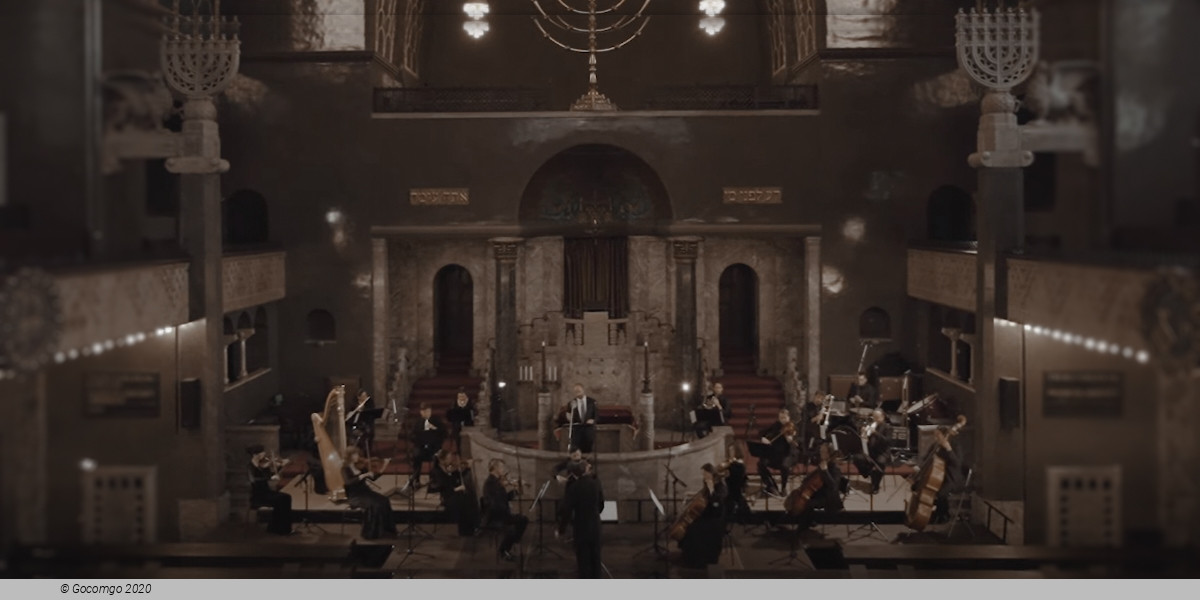
The JEWISH CHAMBER ORCHESTRA MUNICH was founded in 2005 as the Jakobsplatz Munich orchestra by conductor Daniel Grossmann and has since developed a unique profile under his artistic direction: It sees itself as a contemporary Jewish voice, is internationally present on a variety of concert stages and is constantly entering into new alliances and Formats unusual ways to bring contemporary Jewish culture to life and to make it audible, tangible and visible for everyone - an internationally relevant concern that the orchestra has carried out into the world successfully and as a matter of course for 15 years now.
In addition to tours and a. After Israel, Eastern Europe, Scandinavia, North America and China, the JEWISH CHAMBER ORCHESTRA MUNICH is increasingly appearing as an ambassador of Jewish culture at guest performances within Germany. It is an orchestra for all nations and religions. His musicians come from over twenty countries, are Jewish and non-Jewish and mostly live in Germany.
At the highest artistic level, the JEWISH CHAMBER ORCHESTRA MUNICH cultivates the rich Jewish music tradition and a repertoire that extends from the baroque to the present: it brings rarely played works to performance and forgotten Jewish composers * as in the moderated chamber music series Expeditions in cooperation with the NS Documentation Center in Munich or at last year's Mieczysław Weinberg Festival, which received a lot of media attention and was enthusiastically received by the public. The JCOM also fills forgotten places of Jewish life with lively culture: the successful synagogue tour through Bavaria in summer 2019 will also be continued internationally in 2021.
The orchestra regularly awards composition commissions to composers of the new generation, including Richard Ruzicka, Moritz Gagern, Sarah Nemtsov, Nikolaus Brass, Gilead Mishory, Jan Duszynski and, in the 19/20 season, in collaboration with the University of Music and Theater, to two young film composers , Dominic Giesriegl and Josef Piras. It introduces new traditions such as the annual Jewish New Year's Concert, which has been a cantor's concert in Munich's Prinzregententheater since 2014; it surprises with an appearance in a leading role at the Tatort: The music dies last (2017, director: Dani Levy) in the KKL Luzern or with an innovative video concert performance of operetta rarities by Jacques Offenbach; and it maintains long-term collaborations with Munich's cultural institutions such as the Bavarian State Opera (including with Zeisl's Job at the 2014 Opera Festival, with performances of seldom played oratorios such as Mozart's La Betulia liberata, Alessandro Scarlatti's Il primo omicidio, Handel's Jephtha and his large choir oratorio Israel in Egypt , performed by singers from the Opera Studio) or the Museum Villa Stuck.
The JEWISH CHAMBER ORCHESTRA MUNICH works with many internationally renowned singers, instrumental soloists and actors such as Benjamin Appl, Ludwig Mittelhammer, David Orlowsky, Ingeborg Danz, Anne-Sophie Mutter, David Frühwirt, Reto Bieri, Daniel Hope, Sergei Leiferkus, Christoph Prégardien, Wu Wei, Bibiana Beglau, Brigitte Hobmeier, Lambert Hamel, Götz Otto and Sibylle Canonica.
In recent years, the JEWISH CHAMBER ORCHESTRA MUNICH has also made a name for itself as a silent film orchestra, including through cooperation with ARTE at the Berlinale in 2013 (The Student of Prague) and 2018 (The old law, new composition by Philippe Schoeller) as well as through the series Flimmerkammer, which has existed since 2017 in cooperation with the Münchner Kammerspiele, which in the current season with the new Format Jüdische Kinovarieté and the semi-documentary Menschen am Sonntag will be continued.
The education area is now an integral part of the orchestra profile. Mediation projects such as Nacht und Nebel, the first film documentary about the Auschwitz concentration camp (director: Alain Resnais; music: Hanns Eisler) or Through Roses, a music theater work by Marc Neikrug, are regularly on the concert schedule, as is the easily accessible format of the children's cinema with early Cartoons by Walt Disney (music: Paul Dessau).
In the opera school initiated in 2018, part of the "Excellent Orchestra Landscape Germany", a highly regarded funding program of the Federal Government Commissioner for Culture and Media, around 120 children of different social and cultural backgrounds received free singing and instrumental lessons, gained insights into the creation of a professional music theater production and worked on a new production of Benjamin Britten's children's opera Noahs Flut over two years, which was performed in November 2019 and was enthusiastically received by the audience and the press.