Gran Teatre del Liceu tickets 22 April 2027 - The Exterminating Angel | GoComGo.com

The Exterminating Angel

Gran Teatre del Liceu, Main Stage, Barcelona, Spain
All photos (8)
Select date and time
7:30 PM
From
US$ 123

E-tickets: Print at home or at the box office of the event if so specified. You will find more information in your booking confirmation email.

You can only select the category, and not the exact seats.
If you order 2 or 3 tickets: your seats will be next to each other.
If you order 4 or more tickets: your seats will be next to each other, or, if this is not possible, we will provide a combination of groups of seats (at least in pairs, for example 2+2 or 2+3).

Important Info
Type: Opera
City: Barcelona, Spain
Starts at: 19:30
Acts: 3
Duration: 2h 15min

E-tickets: Print at home or at the box office of the event if so specified. You will find more information in your booking confirmation email.

You can only select the category, and not the exact seats.
If you order 2 or 3 tickets: your seats will be next to each other.
If you order 4 or more tickets: your seats will be next to each other, or, if this is not possible, we will provide a combination of groups of seats (at least in pairs, for example 2+2 or 2+3).

Overview

"The Exterminating Angel" reminds us that what is truly sacrilegious is not blasphemy, but empty routine and self-complacency.

“The sacred begins when ritual falters and reveals the abyss” Georges Bataille

Luis Buñuel’s homonymous film becomes a quasi-mythical origin for The Exterminating Angel, the opera by Thomas Adès, a brilliant composer who will also conduct the performances at the Liceu. Adès transforms that unsettling universe into a fascinating sonic architecture: music filled with effects, unusual textures and subtle tensions that opens the doors to a ritual that slowly disintegrates.

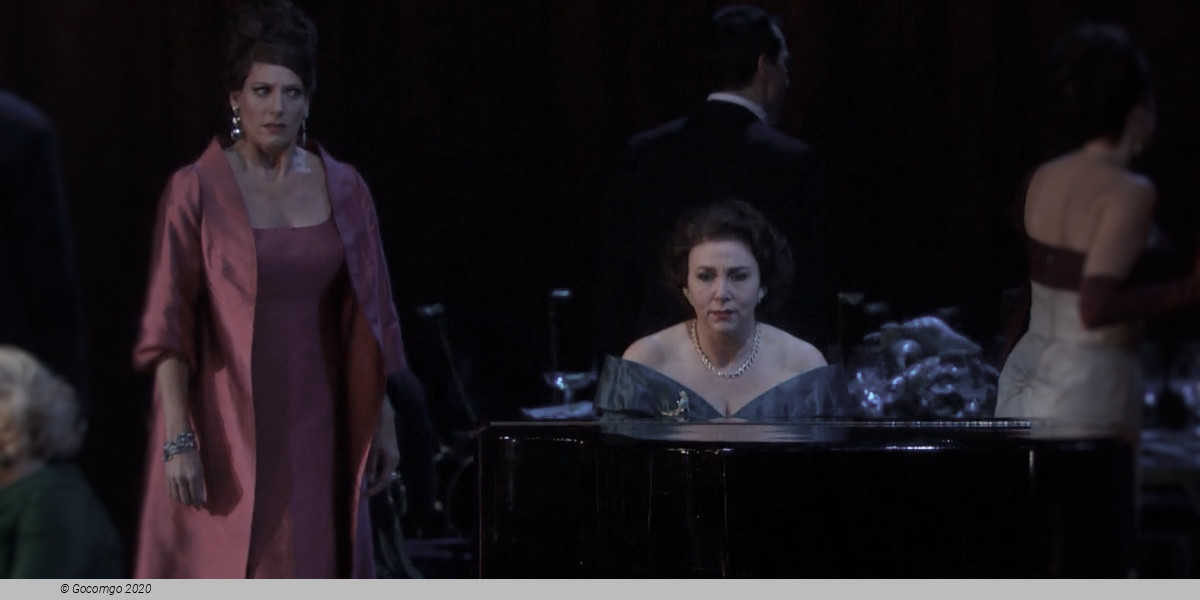
The acclaimed production by Calixto Bieito for the Opéra national de Paris places the audience in a bourgeois and seemingly civilized space: an aristocratic salon that, after a refined dinner, reveals the fragility of its rituals. Where there should be meaning there is only repetition; where there should be freedom, an asphyxiating inertia accumulates. It is in this gap that the exterminating angel emerges: an invisible force that fractures order and exposes the sacrilegious nature of a society that has forgotten the true meaning of the sacred.

The guests, unable to leave the room, witness the dissolution of language, hierarchies and bonds. Elegance turns into animality; the salon into a corrupted altar in which desire and fear displace all etiquette. Adès’s music, full of surprising sonic gestures, amplifies the drama to its limit: a failed ritual, a liturgy disturbed by human self-sufficiency.

In Bieito’s vision there is also an underlying idea of redemption: when the guests accept their vulnerability and repeat the gesture that condemned them, the space dissolves and, with it, the trap. Freedom does not arrive by force, but through surrender. Only when the group embraces its fragility does the door finally open.

The Exterminating Angel imposes no moral; it offers a wound. It reminds us that what is truly sacrilegious is not blasphemy, but empty routine and self-complacency. And that only art, in its capacity to unsettle, can reopen the door to the sacred.

Production: Gran Teatre del Liceu, based on the production of the Opéra national de Paris

History
Premiere of this production: 28 July 2016, Haus für Mozart, Salzburg Festival

The Exterminating Angel is an English-language opera in three acts, with music by Thomas Adès, and a libretto by Tom Cairns in collaboration with Adès. The opera is based on the 1962 film of the same name by Luis Buñuel. The opera, Adès' third, was a joint commission between the Salzburg Festival, the Royal Opera House, Covent Garden, the Metropolitan Opera, and the Royal Danish Opera.

Synopsis

The setting is the mansion of Lucía and Edmundo de Nobile, on the Calle de la Providencia in an unnamed city, in the 1960s.

Act 1

The Nobiles are expecting guests for a dinner at their mansion in honor of the opera singer Leticia Meynar. However, the footman Lucas runs away, and the butler Julio does not stop him. The maids Meni and Camila also try to leave. The Nobiles arrive after attending a performance at the opera. When the guests go into the dining room, Meni, Camila, and several other servants make their escape. The guests repeat their entrance, which momentarily disconcerts Edmundo de Nobile.

At dinner, Nobile toasts Leticia. As Lucía announces the first course, the waiter spills it on the floor. Lucía decides to postpone her other 'entertainments', and a performing bear and several lambs are removed to the garden. The rest of the servants, except for Julio, flee the house, despite Lucía's protestations.

In the drawing-room, Blanca performs at the piano. The engaged couple Eduardo and Beatriz dance. Leonora flirts with Dr. Conde, who declines to dance with her. She kisses him instead. Conde then confides to the explorer Raúl Yebenes that Leonora is gravely ill and does not have long to live. The guests praise Blanca's performance and then encourage Leticia to sing. Señor Russell protests that she has performed enough for the evening. Several guests proclaim that they will not leave the room until Leticia has sung for them.

Several guests prepare to depart, whilst Roc falls asleep. In the cloakroom, Lucía gives her secret lover, Colonel Álvaro Gómez, a fleeting kiss. The guests become lethargic and distracted. Although it is now very late, none of them attempts to leave. Though confused, Edmundo graciously offers to lodge to those who wish to stay. Russell and Colonel Gómez are horrified as some guests remove their tailcoats, but eventually they too lie down to sleep. Eduardo and Beatriz retreat to a private corner to spend their first night together.

Act 2

The guests wake the following morning. Silvia says that she slept poorly. Conde examines Russell and diagnoses him as terminally ill. Julio is supposed to prepare breakfast but reports that no supplies have arrived at the mansion. When Lucía tries to take some of the ladies to her bedroom to freshen up, they cannot leave the dining room. Blanca frets about her children, but even she and her husband Alberto Roc, a conductor, cannot leave. Silvia finds this situation humorous, with the knowledge that her son Yoli is safe with his private tutor, Padre Sansón. Julio approaches with coffee and the leftovers from the previous evening's dinner. Leticia entreats Julio not to enter the drawing-room but in vain. Blanca is desperate, while Raúl sees no reason to get overly excited. Francisco complains that he cannot possibly stir his coffee with a teaspoon. When sent to procure coffee spoons, Julio now finds himself trapped in the drawing room.

Evening approaches. Russell's condition has worsened, as he has fallen into a coma and needs urgent medical care. When they have nothing left to drink, the guests begin to panic. Conde pleads for calm, although even he seems to be losing his composure. Raúl becomes aggressive and blames Edmundo for the situation. Francisco is frantic and resists all attempts to calm him. Russell unexpectedly regains consciousness, expressing relief that he will not live to experience the 'extermination'. The thought of dying amongst all these people, rather than alone with Eduardo, troubles Beatriz.

During the night, Russell dies. Conde and Colonel Gómez haul his corpse into the closet, as Eduardo and Beatriz watch secretly.

Act 3

Police guarding the mansion drive back a crowd of people gathered outside. Although some people break through the police ranks, no one can enter the house.

In the drawing-room, Julio and Raúl burst a water pipe. The guests rush desperately to quench their thirst. Tormented with hunger, everyone begins to behave with increased irrationality. Blanca combs only one side of her hair, driving Francisco to distraction. Unable to find the pills for his stomach ulcer, Francisco thinks that someone has hidden them. Raúl goads Francisco about his relationship with his sister, and the two men exchange insults. Edmundo tries with difficulty to keep the peace. Leonora, in great pain, entreats the assistance of Dr. Conde and the Virgin Mary. Blanca's smell nauseates Francisco, and he again loses his nerves.

Whilst delirious, Leonora sees a disembodied hand wandering around the drawing room. Trying to stop it, she stabs Blanca's hand with a dagger. In the closet, Eduardo and Beatriz decide to kill themselves. Roc assaults Leticia, but Raúl accuses Colonel Gómez instead. Edmundo is injured during the ensuing scuffle. The lambs wander from the garden into the drawing room.

The army has quarantined the mansion. Padre Sansón appears with Yoli, and the crowd demands that Yoli be sent inside. Encouraged by the crowd, Yoli tries to enter the mansion but is unable to.

The guests have slaughtered the lambs and are cooking them on a makeshift fire. Leonora recalls a premonition from the night of the opera performance and attempts a magic ritual with Blanca and Leticia. The ritual fails, but she declares that innocent blood is needed. Francisco discovers Eduardo and Beatriz's bodies in the closet. In a fresh quarrel, Raúl tosses Francisco's box of pills out of the drawing room. Silvia cradles the corpse of one of the lambs in her arms, thinking that she is rocking Yoli to sleep.

The bear appears across the threshold. Gradually the idea spreads among the guests that a sacrifice is required to secure their liberation, specifically the death of Edmundo. Conde and Colonel Gómez unsuccessfully try to dissuade this idea. Edmundo declares that he will sacrifice himself, but Leticia interrupts him. She realizes that, at this moment, each of them is in exactly the same place as at the start of their strange captivity. With her encouragement, the others hesitantly repeat their actions from that first night, but one character acts differently at one key point. This change allows the characters to approach the threshold and finally cross it. The guests and the crowd outside the mansion meet.

Venue Info

Gran Teatre del Liceu - Barcelona
Location   La Rambla, 51-59

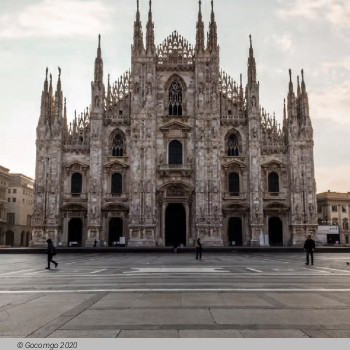
The Gran Teatre del Liceu, or simply Liceu in Catalan, is a main opera house in Barcelona, Catalonia, located on the central street of the city - La Rambla. The Liceu opened on 4 April 1847.

The Gran Teatre del Liceu dates back to 1837 when at the instigation of Manuel Gibert, a battalion of the National Militia formed the institutional core of the future Teatre in the unused monastery of Montsió (currently Portal del Ángel): a dramatic society of aficionados devoted to the performing arts. The first show premiered on 21 August 1837: El marido de mi mujer, by Ventura de la Vega, a dance number and a skit.

Origins (1837–1847)
In 1837, the Liceo Filodramático de Montesión (Philodramatic Lyceum of Montesión, now named Conservatori Superior de Música del Liceu) was founded in Barcelona to promote musical education (hence the name "Liceo", or lyceum) and organize scenic representations of opera performed by Liceo students.

A theatre was built in the convent building — named Teatro de Montesión or Teatro del Liceo de Montesión — and plays and operas were performed: the first was Vicenzo Bellini's Norma (3 February 1838). The repertoire was Italian, the most performed composers being Donizetti and Mercadante as well as Bellini and Rossini. The Barcelona premiere of Hérold's Zampa was held here.

In 1838, the society changed its name to Liceo Dramático Filarmónico de S. M. la Reina Isabel II (Dramatic Philharmonic Lyceum of H.M. Queen Isabel II). Lack of space, as well as pressures, brought to bear by a group of nuns (who were the former proprietors of the convent and had recovered rights to return), motivated the Liceu to leave its headquarters in 1844. The last theatre performance was on 8 September.

The Trinitarian convent building located in the center of the town at la Rambla was purchased. The managers of the Liceu entrusted Joaquim de Gispert d'Anglí with a project to make the construction of the new building viable. Two different societies were created: a "building society" and an "auxiliary building society". Shareholders of the building society obtained the right of use in perpetuity of some theatre boxes and seats in exchange for their economic contributions. Those of the second society contributed the rest of the money necessary in exchange for property of other spaces in the building including some shops and a private club called the Círculo del Liceo.

In contrast with many other European cities, where the monarchy took on the responsibility of the building and upkeep of opera houses, the Liceu was funded by private shareholders of what would become the Societat del Gran Teatre del Liceu (Great Liceu Theatre Society), organized similarly to a trading company or society. This is reflected in the building's architecture; for example, there exists no royal box. The Queen did not contribute to the construction, so the name of the society was changed to Liceo Filarmónico Dramático, removing the Queen's name from it.

Miquel Garriga i Roca was the architect contracted; the construction began on 11 April 1845. The theatre was inaugurated on 4 April 1847.

Opening, fire, and rebuilding (1847–1862)
The inauguration presented a mixed program including the premieres of José Melchior Gomis' musical Ouverture, a historical play Don Fernando de Antequera by Ventura de la Vega, the ballet La rondeña (The girl from Ronda) by Josep Jurch, and a cantata Il regio himene with music by the musical director of the theatre Marià Obiols. The first complete opera, Donizetti's Anna Bolena was presented on 17 April. At this point, Liceu was the biggest opera house in Europe with 3,500 seats. Other operas performed in the Liceu during the first year were (in chronological order): I due Foscari (Verdi), Il bravo (Mercadante), Parisina d'Este (Donizetti), Giovanna d'Arco (Verdi), Leonora (Mercadante), Ernani (Verdi), Norma (Bellini), Linda di Chamounix (Donizetti) and Il barbiere di Siviglia (Rossini).

The building was severely damaged by fire on 9 April 1861, but it was rebuilt by the architect Josep Oriol Mestres and re-opened on 20 April 1862, performing Bellini's I puritani. From the old building, only the facade, the entrance hall, and the foyer (Mirrors Hall) remained.

Bombing and civil war (1862–1940)
On 7 November 1893, on the opening night of the season and during the second act of the opera Guillaume Tell by Rossini, two Orsini bombs were thrown into the stalls of the opera house. Only one of the bombs exploded; some twenty people were killed and many more were injured. The attack was executed by anarchist Santiago Salvador and deeply shocked Barcelona, becoming a symbol of the turbulent social unrest of the time. The Liceu re-opened its doors on 18 January 1894, but the seats occupied by those killed were not used for a number of years. The second bomb was put in the Van Gogh Museum in 2007 during an exhibit on Barcelona around 1900.

In 1909, the auditorium ornamentation was renewed. Spanish neutrality during World War I allowed the Catalan textile industry to amass enormous wealth by supplying the warring parties. The 1920s were prosperous years and the Liceu became fully established as a leading opera house welcoming better singers, the orchestra leaders of the time, and companies such as Sergei Diaghilev's Ballets Russes.

When the Second Spanish Republic was proclaimed in 1931, political instability meant that the Liceu suffered a severe financial crisis which was only overcome through subsidies from the Barcelona City Council and the government of Catalonia. During the Spanish Civil War, the Liceu was nationalized and took the name the Teatre del Liceu – Teatre Nacional de Catalunya (Liceu Opera House – the National Theatre of Catalonia). The opera seasons were suspended. After the war, it was returned to its original owners in 1939.

"Silver Age" and crisis (1940–1980)
From 1940 to the 1960s, the seasons were high-quality ones. 1955, thanks to the creation of a special board, saw a historic event when for the first time since its foundation, the Bayreuth Festival was staged away from its normal venue. Performances of Parsifal, Tristan und Isolde, and Die Walküre with innovative stage sets by Wieland Wagner were enthusiastically received.

In the 1970s, an economic crisis affected the theatre and the privately based organization could not afford the increasing budgets of modern opera productions and general quality declined.

New direction and second fire (1980–1994)
The death of Joan Antoni Pàmias in 1980 revealed the need for the intervention of the official bodies if the institution was to remain a leading opera house. In 1981, the Generalitat de Catalunya, with Barcelona's City Council and the Societat del Gran Teatre del Liceu, created the Consorci del Gran Teatre del Liceu (Consortium of the Great Liceu Theater) responsible for the theatre's management.

The Deputation of Barcelona and the Spanish Ministry of Culture joined the Consortium in 1985 and 1986 respectively. The Consortium managed to quickly attract the public back to the Liceu owing to a considerable improvement in its artistic standard. This included a more complete and up-to-date perspective of the very nature of an opera performance, a great improvement in the choir and orchestra, careful casting, and attracting the interest of the public to other aspects of productions besides the leading roles alone. This approach, coupled with the new economic support and more demanding and discerning public, resulted in a high standard of production.

The seasons organized by the Consortium maintained high standards in casting, production, and public loyalty, as measured by public attendance, but all this came to a halt with a fire on 31 January 1994. The building was destroyed by a fire caused by a spark that accidentally fell on the curtain during a routine repair. At this time, Paul Hindemith's Mathis der Maler was performing at the theatre and the following opera to be performed was Puccini's Turandot.

The public and institutional response were unanimous on the need to rebuild a new opera house on the same site with improved facilities. The new Liceu is the result of a series of actions to preserve those parts of the building unaffected by the fire, the same ones as had survived the fire in 1861. The auditorium was rebuilt with the same layout, except for the roof paintings which were replaced with new artworks by Perejaume, and state-of-the-art stage technology.

To rebuild and improve the theatre, it became public. The Fundació del Gran Teatre del Liceu (Liceu Great Theater Foundation) was created and the Societat del Gran Teatre del Liceu handed over the ownership of the building to the Foundation. Some owners disagreed with the decision, which was challenged unsuccessfully in court.

Reopening (1994–present)
From 1994 until the reopening in 1999, the opera seasons in Barcelona took place in: Palau Sant Jordi arena (only some massive performances in 1994), Palau de la Música Catalana, and Teatre Victòria. The rebuilt, improved, and the expanded theatre opened on 7 October 1999, with Puccini's Turandot as previewed in 1994 before the fire. The new venue had the same traditional horseshoe-shaped auditorium as before but with greatly improved technical, rehearsal, office, and educational facilities, a new rehearsal hall, a new chamber opera and small performances hall, and much more public space. Architects for the rebuilding project were Ignasi de Solà-Morales and Xavier Fabré i Lluís Dilmé.

Surtitles, projected onto a screen above the proscenium, are used for all opera performances and some lieder concerts. The electronic libretto system provides translations (to English, Spanish, or Catalan) onto small individual monitors for most of the seats.

Important Info
Type: Opera
City: Barcelona, Spain
Starts at: 19:30
Acts: 3
Duration: 2h 15min
Top of page